Reasons For Corset Training

Tight-lacers love the individuality of customising the body, a lot of modern corset training is practised because the wearer wants to follow their own idea of beauty rather than the reasons of old when corset training was practised to conform to society in the Victorian era. This is by far the biggest change that has taken place within the practise of Waist training. Today its about empowering women (and men) rather than constraining them! So I’d like to point out that you should be corset training for you and not your peers, boyfriend, job etc.

So beside customising your body what other uses does the humble corset have? There are actually medical benefits to a tight laced corset. Medical corsets are used for back pain and spine deformaties. If your looking into them for this reason you should ask your doctor to direct you to a specialist. But a much more likely reason for you my readers to be waist training is to loose weight. Corset training is great for helping to reduce your weight. Obviously it needs to be in addition to exercise and a sensible diet but you’ll find you physically can’t eat as much while wearing one. We’ll go into the ins and outs (yes I know, bad pun) of eating and diet in next weeks posts.

Technorati Tags: Corset Training, tight lacing, waist training, weight loss

Tightening Your Laces Alone For Corset Training – Rabbit Ears Method

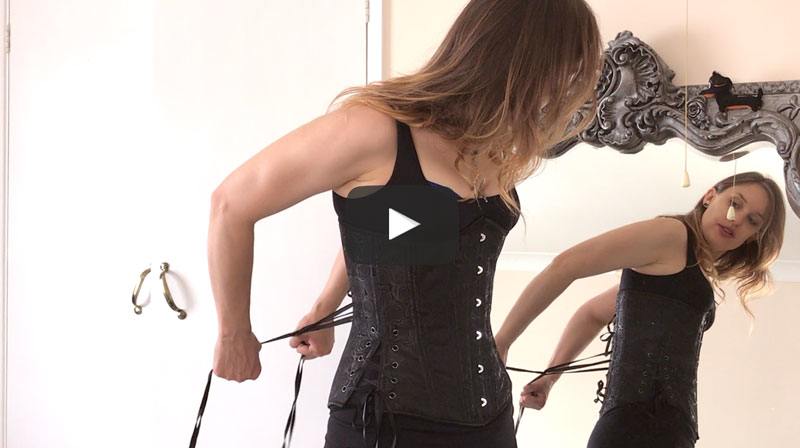
You can easily use the ‘rabbit ears’ method of lacing your corset training corset to make getting into your corset unassisted supper easy. It involves lacing the corset in the traditional criss crossed method until you get to the waist line, then leaving two big loops of lace (the loops represent the rabbit ears) then continuing to the bottom where you tie them off and cut off the excess. You need to leave the loops long enough to completely loosen the corset to the point where you can put it on/take it off easily. You then pull the loops to tighten the corset and tie them in a bow. The knot at the bottom of the corset never gets untied, unless you want to change or replace the laces. Here’s a diagram of the lacing for rabbit ears, if you have a waist tape on your corset training corset make the loops at this point.


You can then easily loop the rabbit ears over a door handle if you need an extra hand while tight lacing. You then just walk away from the door, using your body weight to tighten the corset. I posted some photos of my friend using the door handle method back in 2011 – check out the post of her first corset training corset lacing here

Here’s one of the photos to illustrate how easy it is to loop the ‘rabbit ears’ over a pair of door handles.


Technorati Tags: Corset Training, tight lacing, waist training

Corset Patterns for Corset Training (6)

Corset Pattern Piece Numbers

Another important thing to look for when choosing your corset pattern is the number of pattern pieces it has. This may not be obvious to the novice corset maker but the more pieces the better the shape and the stronger the corset.

Imagine the corset as a three-dimensional and fairly ridged shape, like the cubes and pyramids you played with in kindergarden. To follow the curves of the body closely it needs as many sides as possible. This allows for more comfort and a better fit.

As well as a better shape, more pieces also makes for a stronger garment. Corset bones are normally placed at the seams; either one bone next to the seam or two with the seam running down between them. Thus the more seams the more bones and the more bones the stronger the corset structure. A plus size corset especially should have at least 5 or 6 pieces per side (the corset pattern will normally make up just one side, when you make a corset you cut two lots of materials – flipping the pattern over in between). A corset training corset will often have 8 or more pieces per side if its custom made by a specialist maker who designs for serious tight lacers.


TBC

Technorati Tags: corset patterns, Corset Training, make a corset, tight lacing, waist training

Corset Patterns for Corset Training (5)

Corset Shapes

There are even more corset pattern shapes to choose from than lengths (on hips, over hips etc, see last few posts for more details). Below are examples of the main ones, the top line shows those commonly used for corset training, the second row are the more exotic but also more problematic corset styles that I don’t recommend for waist training, they’re included for educational purposes.

The waist cincher has been covered in the previous posts – this is the same as a ‘waspie’ or short underbust and is for active wear. The two main types you’ll have to choose between are the hour glass and the conical shape.

The hour glass corset pattern is named after – you guessed it – the hour glass, the ones filled with sand, as its wide at both the top and bottom but goes in dramatically in the middle. The important thing to note here is that this pattern allows for the ribs, you should have little or n trouble taking full lung-fulls of air while waist training in this style. The conical corset however, squashes the ribs which are forced into an upside-down cone shape that tapers down to the waist. This style will restrict lung capacity and over time corset training with a conical corset is said to change the shape of the ribs permanently. A lot of tight-lacers consider this the proper corseted body shape.


Technorati Tags: corset patterns, corset shapes, Corset Training, tight lacing, waist training

Corset Training – How Long & How Fast? (3)

So we discussed earlier the daily time scale for waist training but how about reduction scale? How far can you and should you go when corset training? And how quickly can you expect to get there?

Again there are no hard and fast rules, everyone is different and my best advice is to listen to your body and accept its limits. It can become a compulsion for some people – getting that last half inch, fitting back into that wedding dress. Its dangerous if you don’t stop when it feels wrong or even starts to hurt.

That said generally its easier to reduce down the first 2-4 inches, these are sometimes managed within 6months, then it can take up to a year per half inch. People with a lot more body fat will find it easier to compress their body than those of a leaner build and combining corset training with weight loss means there are no hard and fast rules to follow as your body mass is reducing along side any corset induced waist reductions.

Technorati Tags: Corset Training, waist reduction, waist training

Corset Training – How Long & How Fast? (1)

I’m asked a lot how long you need to tight lace to start physically reducing your waist line and how fast you can start squeezing the inches away.

Corset Training isn’t supposed to be a quick fix (although it does instantly slim your figure when you don a corset) it’s meant to be a way of life. Thats not to say you can only waist train if you plan to eat, sleep and work in your corset. It does mean that you have to enjoy wearing a corset for long periods and it does mean you need to reduce your waist slowly and sensibly.

That said we can go into the hows and how longs in more detail:-

When you start off make sure you get a well fitting corset and brake it in by wearing it for a few hours a day for a week or so ideally. You then need to build up the hours slowly, it needs to be gradual enough for your body to almost ‘not notice’ the change. You’ll feel very restricted and uncomfortable if you go straight for an 8 hour stint. But move up an hour a week from 2 to 8hrs and you’ll almost forget your wearing it.

TBC

Technorati Tags: Corset Training, tight lacing, waist training

Corset Training Corsets

Defining the Corset Training Corset:

The difference between a regular corset and a corset training corset or tightlacing corset is in the structure and strength. It is used for ‘body modification’ which means it has to have the strength to physically alter the shape of your body for extended periods of time until this becomes permanent to some degree (when taking off a corset you can’t expect your waist to not expand to some degree even after years of corset training).

To take this kind of long term strain a tightlacing corset has to be made of coutil ideally, I won’t go into the other materials that have been debated over the years, for me it has to be coutil. This is a strong stretchless cotton with a ‘herringbone weave’. Heres an example:-

The smaller the herringbone weave the less give the fabric should have and the better it is for corset making.

You can get satin coutils that aren’t herringbone weave, these materials aren’t as a rule as strong as the above type but make an excellent outer layer when coupled with a herringbone coutil lining. Which brings me onto my next point which is the layering. You can sometimes get by with a single layer of coutil, I’ve definitely seen a number of historic corsets made of a single layer. But remember the women that wore them had been corset training from a very young age and had tiny waists to support. If you are learning how to make a corset to reduce your waist substantially over time (or a customers waist), especially if it is a large or plus sized corset pattern – use two layers of coutil! You can often find three layer waist training corsets available commercially that have an outer layer of fashion fabric and two coutil layers for strength.

My last point to make on corset training corsets is the number of bones. Lets establish firstly tho that they should be made of steel not plastic. Often referred to as ‘steels’ corset bones can be made of two types of steel, sprung steel and spiraled steel wire, as below:-

Sprung steel boning comes with the ends rounded and tipped with a plastic. You can buy a continuous reel that can be cut with tin snips, rounded with a metal file and dipped in a liquid tipping fluid. Spiral steels need to be cut and capped with small metal U tips.

In a corset training corset you should expect to find the seams double boned, ie two bones at each seam with the seam running in-between. Some corsets will have more, the more bones the more strength and comfort the corset should provide. And that concludes the basics you should look for in a corset training corset.

Technorati Tags: Corset Training, how to make a corset, waist training

Braking in your Waist Training Corset

When you get a new corset training corset you’ll need to ‘brake it in’ before you start corset training.

To do this you’ll simply need to find 3 separate occasions to wear your corset training corset around the house, or for an hour or two somewhere you won’t have to do anything strenuous.

You’ll want to put your corset on and very gradually tighten it, thus allowing the corset to mould to your body, while also getting your body used to the shape and feel of the new corset. This will also allow the tension in the fabric to ease at the stress points making popped eyelets and ripped seams less likely.

By “settling in” to your corset like this you can avoid the pains and aches that have been associated with corset training like back pain for example. These discomforts come from wearing a corset too tightly for your body, new corsets that haven’t been properly broken in will aggravate these problems.

Technorati Tags: Corset Training, waist training

Corset Training Before And After 1

So what you need to know before corset training and what you can expect after?

Now I know I say this a lot but you really can’t rush or force your body into corset training. There really is no point to jumping straight into a corset, forcing your waist down by a 5inch reduction and saying “there! I’m a tightlacer!” Because you’ve then got to keep that corset on 8 – 12+ hrs a day for the next 6months to make the reduction permanent, or as permanent as a corseted waist gets. (Everyone’s waist expands a certain amount when they take off their corset, even after years of corset training.) You’d be lucky to last a day with such a violent reduction before giving up on account of the discomfort and or pain. I’m being over dramatic but my point is this – if your planning to corset train you need to be in it for the long run, not the short sprint! Waist training is a way of life, it affects your eating habits, sleeping habits, your movement etc etc. It IS rewarding but only for those who enjoy the process as much as they enjoy the end result. You shouldn’t tighten your corset to the point where it feels uncomfortable, your corset should support and ‘hug’ your body rather than crushing you. If it hurts your doing it wrong.

We continue this little chat with more detailed info on corset training before and after here…

Technorati Tags: Corset Training, Corset Training Before And After, tightlacing, waist training

Tight lacing your corset alone

Last night I helped a friend into her first corset training corset and showed her the over the door handles method for tightening her corset alone. This is a great method for beginners because it’s like having a second pair of hands holding the laces taught while you pull at the crossed laces up and down the corset to get an even tightness top and bottom. Here are a couple of photos we took.

tight lacing alone.jpg

door handle tug.jpg

Technorati Tags: Corset Training, tight lacing, tightlacing, waist training

How small is too small?

One of the questions I see discussed in corset training forums regularly is what size corset to buy, how small is too small when your loosing weight?

A lot of women (and a few men) tight-lace in conjunction with dieting and as they loose weight their waist gets smaller too. Corsets are very expensive so getting the size right to last you a good 4-6 months is important. Nothing puts you off shrinking your waist like knowing you’ll have to fork out for a new corset next month at the rate your going.

So should you get a corset the recommended 4 inches smaller than your natural waist or should you go smaller? There’s no easy answer to this I’m afraid, the best method for working it out is to go into a shop and try some on if your getting an off the peg. If your having one custom made you can check in the mock-up stage if you can take an extra inch or two off and not be uncomfortable/have too big a gap at the back. Make sure if your going custom (and not making it yourself) that your maker goes through the mock up stage and you get to try it on. I’ve ordered some custom corsets from overseas to see how well they would fit – unfortunately none of them were wearable! And off the pegs always fit me. So when in doubt try them out and make sure if you order online you can return them if they don’t fit.

Technorati Tags: Corset Training, waist training

Diet and exercise while corset training

So we’ve discussed getting your body used to a corset gradually by building up the hours you spend in it day by day. But really this is only part of the process. The other two areas of body management you need to pay attention to while corset training are diet and exercise.

Yes every other magazine, advert and doctor goes on about the importance of diet and exercise but your about to become (or are already) a tight-lacer. These areas are too important to let slide.

Diet does not automatically mean under eating, it does mean eating sensibly. Wearing a tight corset also means eating differently. You can’t eat a big meal in a corset it’ll make you feel ill! You’ll be eating smaller meals more often and never eat until your uncomfortably full. In certain parts of the world – the med I believe – it’s customary to eat until your 90% full. This is a good rule to follow. I don’t need to remind you its important to eat your greens etc but you must make sure you eat enough roughage as squeezing your insides will make processing food that much slower for your intestines. Yes not very glamourous but you’ll thank me later.

Exercise is the other big corner stone of the happy tight-lacer. A mixture of cardio and core strengthening exercises are recommended to combat the undesirable effects of corset training. I go for a jog in the mornings and do the boat position when I get back before my morning shower. But fit it in where it suits you. A keep fit class, swimming or a home fitness DVD three times a week all work well to get your heart beating fast and you breathing heavily. The point of which is to expand your lung capacity as well as keeping you fit. Wearing a corset will alter the shape of your bottom ribs so you’ll benefit from expanding the intake of the top part of your lungs. If you don’t think you’ll stick to an exercise regime then going to a class or exercising with a friend will help stop you ducking out, even programming reminders into your phone so it tells you to ‘get your butt outta bed and onto that treadmill now’ can work.

Core muscle exercises are also important (core means the big inner tummy muscles) as wearing a corset takes the strain off them – great for back pain but it weakens the muscles. There are some great tummy exercise videos out there but try to steer clear of crunches they can do a lot of damage especially if you’ve had children. I like the boat, it’s quick and simple and I get to lay on the floor :)

To do the boat position you lay on the floor arms by your sides, pull in and tighten your tummy muscles and holding them in you lift your head shoulders and feet off the ground a few inches and hold for 10 seconds. Repeat a few times. Work up to 30seconds 3-5 times. Easy and quick.

Technorati Tags: Corset Training, tight lacing, waist training

Mr Pearl – France – age 43 – 18 inch waist – 5ft 8in tall

Mr Pearl, corsetier to the stars

Mr Pearl, corsetier to the stars


“My work is not about being fashionable. I do not follow fashion at all. I’m interested in an ideal, a kind of expression of elegance, which really has nothing to do with fashion.”


The infamous Mr Pearl has an 18-inch corseted waist and wears his corset 24 hours a day, 7 days a week except to bath. But his work as a ‘Corsetier’ or maker of corsets is what really skyrocketed him to fame and glory.


Mr Pearl is arguably the most amazing Corsetier in existence, his works of art can take several months each to construct. He has made corsets for designers such as Jean Paul Gaultier, Thierry Mugler, John Galliano, Chloe, Alexander McQueen, Antonio Berardi and Christian Lacroix. And for famous ladies like Kylie Minogue, Dita Von Tease and Jerry Hall.


“It was Mr Pearl who laced Posh Spice into her wasp-waisted Vera Wang wedding dress, created Mugler’s more extreme and infamous metal biker corsets, and more recently tied Sophie Dahl into the ballet-shoe pink corset dress of Gaultier’s spring/summer 2001 collection.”

The Independent, 24th Nov 2001, Forrest, Emma E


The infamous Mr Pearl is the alter ego of Mark Pullin, he started tightlacing at age 30, after seeing a photograph of Fakir Musafar:


Fakir Musafar waist size 19inch nineteen inches 1959 and perfect gentleman

Fakir Musafar

Fakir Musafar’s artistic self-portraiture - ‘nineteen inches’ 1959 and ‘perfect gentleman’ also 1959


Mark Pullin was born in South Africa, he was the eldest son of an English toolmaker, Neil, and a half-English, half-Dutch mother, Yvette. He has a brother , Grant, a motorcycle mechanic. His parents split up when he was three, when he moved in with his grandparents Hetty and Ruben Searle.


“My grandmother wore corsets so I became fascinated by them,” he said. “They were always salmon-pink. She used to let me lace her up. It took a long time as there were lots of eyelets and laces, but it was a great treat.”

Mail on Sunday, 03 April 2005,  Collcutt, Deborah


Pressure to conform led to a 2 year marriage to a South African actress, after which he moved to London, creating his alter-ego Mr Pearl and setting up shop as a corsetier in 1994. He moved to Paris in 2002 where he now works in the romantic setting behind Notre Dame Cathedral, designing unique pieces for couture houses. He refuses to use any form of modern technology, and their are few photos of him or his work – outside of catwalk and fashion shoots that is.


An exquisit example of Mr Pearl’s hand sewn sequined Corsets:

mr Pearl sequinned corset


Mr Pearl’s Metal ‘Biker’ Corsets for Thierry Mugler, later worn by Beyonce:

Theirry_Mugler_Motorbike


Beyonce Thierry Biker Corset


The Sophie Dahl Gaultier dress spring/summer 2010 made by Mr Pearl:

Sophie Dahl Gaultier dress by mr pearl


And Finally, Dita Von Tease in one of her personal Mr Pearl corsets, (and I think we all agree she’s a lucky lucky girl):

dita von tease in mr pearl corset


“Corsetry is the deepest, most intimate, most enhancing possibility physically and I’m fascinated by this. Corsetry presents endless, almost unobtainable, possibilities, it could always be tighter, more beautiful, longer in the front. The limit is physical – outward appearances are endless.” Mr Pe

Dita in Gaultier’s a/w 2010 catwalk

Technorati Tags: Burlesque Corset, Corset Dresses, Corset Training, mr Pearl, waist training

© Copyright Corset Training - Designed by Pexeto