Corset Training Before And After

Your body will change shape instantly the moment you put on a proper corset training corset and tighten the laces. This is because the corset will displace the fat around your middle and hold your body in the shape of the constructed garment, so you can literally design your own body shape. However your body will return to its natural state once you take off the corset. Yes its a shame it can’t just stay put.

So what, if any are the permanent effects that can be achieved with a corset and how long do they take to make permanent?

Rib re-shaping

The only permanent change you can make to your body using corset training is to the lower ribs, which will compress over time to follow the shape of your corset. For this you’ll need a conical corset rather than one with an hour glass shape as these types leave room for the ribcage. Click here for more details on corset training shapes. The above and below pictures are a little extreme as they are copies from historic drawings, but it gives you an idea of the corset training before and after effects. The bottom floating ribs are easily reshaped as they’re not attached at the front. But it will still take a good 6 months to make a significant difference.


Internal Organs

If you plan on tight lacing to the extreme, your internal organs will be affected. The corset will restrict your waist, causing your organs to shift. This does place added pressure on your organs but this is similar to the pressure a woman’s body goes through during pregnancy. The female body is designed to take the added pressure and organ movement but if you plan on undertaking extreme tight lacing you should do so under your doctors supervision.


Body shape

The fact that the corset training before and after effects are not permanent and your body shape is merely held in position until the corset is removed, does not mean that corset training won’t have some effect on your body shape over time. We are talking years though, rather than months. The ribs are a solid bone structure so are unlikely to fully revert back to their original position, soft tissue however, will tend to expand back to its original shape. You would be best advised to corset train as a way of maintaining a slender figure rather than obtaining it, ie someone who starts to tight lace as a young woman will keep her figure thin even as an older woman. Thats why in Victorian times women where corseted as children. The body would form around the corset shape allowing them to maintain the waist size of a young teen. If you do waist train down to a tiny size and maintain it for several years before stopping, you’ll probably remain a great deal thinner than you would have been for several years. However there are reports of it taking under a year for the body to return to its previous size as, just like after pregnancy, the torso seems to remember its natural state. This really does vary from one person to the next though. Corset training really is more a way of life than an alternative to the surgeons knife or a healthy lifestyle. It’s no quick fix and should be undertaken for the joy of tight lacing and with a ‘long term’ mindset.

Technorati Tags: corset making, Corset Training, how to make a corset, tight lacing

Adding Extra Boning Channels

If your learning how to make a corset and your pattern doesn’t have enough boning channels, it can seem a bit daunting to just add in extra ones but it really is that simple. A corset training corset will often benefit from a few more bones as your going to be putting enormous pressure on the garment and the bones are what gives it strength and shape.

There are a couple of ways to sew in extra boning channels and it pretty much depends on the look your going for.

If your bones run down the side of your seams then you can just mirror them with a second set of channels down the other side of the seams. This will give you double boning at each seam and can be more comfortable than a single bone which doesn’t lay as flat against the skin.

If you want to add bones for decoration then you may want to place extra ones on the outside of the corset using boning tape (this is a tube of cotton that the bones slip into, you sew two lines of stitching just over 1mm in from each edge so the bone slips down between them). You can also use ribbon or bias binding if you can’t find the right color or want a satin material for these outer casings. Black satin bias looks striking on a red satin brocade fabric for example. These channels can go next to the seams or down the middle of pattern pieces to suit your own design needs.

Technorati Tags: Corset Training, how to make a corset

Personalize Your Corset Training Corset

So we’re learning how to make a corset? Then why not have some fun with it and make yourself a corset you can’t get anywhere else?

That sounds difficult, I’m only a beginner Scarlet! Ah but I’m not talking about fancy lacework or intricate design features. You can start with a unique fabric!

If your thinking its going to be difficult or expensive to imprint your personality on your own corset then think again. If your having a corset training corset custom made it quickly becomes expensive, but when your sewing it yourself whats stopping you being more flamboyant? There really are so many beautiful fabrics out there, along with trims and iron on appliqués. When it comes to buying fabric you need so little for a corset that you can go for the expensive luxury stuff. If it doesn’t have a large and obvious pattern for you to match up then a half meter is plenty. I’ve gotten short underbusts out of a quarter meter before! This is about the only aspect of making such a small and somewhat fiddly garment that works in the seamstresses favour.

You really can pick literally anything when it comes to picking a material for the outside of your corset, I recommend you avoid Lycra’s, very thin fabrics and stretch fabrics however, as these can be difficult to sew. I love quilting fabrics myself, but they don’t sit as smoothly as brocades and luxury upholstery fabrics which are more commonly used in corsets and really are perfect for the beginner. If you do go for a light-weight material like quilting cottons, then use an iron on backing fabric for added strength and to stop the wrinkling that occurs with thinner fabrics when used for corsetry.

If your completely new to corsetry and need full instructions check out my Express Corsetry Course which includes illustrated step-by-step instructions, 10 corset patterns and a full video on how to make a corset – it costs about what you’d pay for 2-3 shop bought corset patterns!

Technorati Tags: corset patterns, Corset Training, how to make a corset, make a corset

Corset Patterns for Corset Training (10)

Corset Bones – Corset bones come in three main materials which are plastic, sprung steel and spiral steel. They also come in different widths, 5mm and 7mm are most common but I have worked with 4mm and 9mm too. These are the most common sizes but I don’t doubt there are others readily available out there. The number of bones in the corset is also crucial, too few and your corset will not hold its shape and will probably rip easily. You should check your pattern for number of bones. If your making from a corset pattern that covers sizes 6 to 18 for example, and there are the same number of bones for all sizes, you may find the boning is inadequate for the size 18. You can sometimes remedy this by double boning the seams (sewing in a bone each side of the seam giving you twice the strength).

Eyelets – Your eyelets should be metal and set between two sprung steel bones, spiral doesn’t work so well as it bends in all directions. Eyelets come with or without washers (a metal disk with a hole in the middle) either are fine but a washer will make your seams less likely to pop. Spacing is also important, if they’re too far appart this places too much stress on each eyelet and the material around it. This can lead to poped eyelets. Check your pattern for eyelet spacing – I wouldn’t go further appart than an inch and a half for corset training purposes. Check also for boning channels either side of the eyelets, if they’re not present on the pattern you will need to modify it to include room for them.

Waist Tape – The presence of a waist tape on your pattern is not crucial you can add one anyway if you know how. You also don’t need to have one but it does provide support at the point on the corset that will be under most stress when your corset training with it. It also insures the waist area stays in place and does not stretch, this is aesthetically more pleasing as the corset keeps its dramatic curves and tiny waist line. Waist tape should be made of petersham ribbon, this is traditionally used as it doesn’t stretch.

Laces – You can use any non-stretch material but heavy duty laces are best, these don’t slip the way ribbon does so if your self lacing you can pull the laces tight at the top and they won’t slip before you can pull the slack through further down the corset. If you prefer to use ribbon or something else by all means do. I know hiding two or three meters of heavy-weight lacing under a tight fitting t shirt can be a real hassle! You can use the rabbit ear method of lacing and loop the rabbit ears over a door handle if you need an extra hand. I’ll explain this method of tight lacing in more detail in my next post.


Technorati Tags: corset pattern, Corset Training, how to make a corset

Corset Patterns for Corset Training (9)

Corset Construction

Learning how to make a corset training corset is very different to learning how to make corset style lingerie or fashion wear. This is not a direct issue when looking for a corset pattern to work from, unless you plan on relying solely on the instructions that come with it to make your corset. (For a comprehensive corset making course check out my Express Corsetry Course for everything on how to make a corset for corset training purposes).

So what are the most important things to look for in the construction of a corset training corset?

Well your highest priority should be the material its made from, also the number of layers of fabric. The corset bones, width, material and the number of bones used are important too. Then there are the eyelets, waist tape and laces that all need considering. Lets look at each aspect in more detail.


Coutil – By far the best thing to make a corset from is coutil. This is a cotton fabric desgned speciafically to make corsets from. It has a herringbone weave to it and little to no stretch. You want to get 100% cotton where possible as this allows the skin to breathe but polycotton blends are available. This fabric is normally available in white and black, with nude/beige being less common but you can dye the fabric easily. Satin coutil is also available in a variety of colors and patterns but can often be three times the price and lacks the herringbone weave so is a little more prone to stretching. If you want a pretty outer fabric the most popular method is just to add a layer of ‘fashion fabric’ which can be any fabric of your choosing although stretch fabrics can be problematic. A heavy-weight or upholstery fabric is best as it lays flatter and smoother on the curves of the body and adds support to the coutil layer.

Number of Fabric Layers –  Opinions on how many layers a corset training corset needs are divided. I used to believe myself that waist training corsets needed at least two layers, but I have since bought antique corsets from the Victorian era that were clearly worn on a daily basis for tight lacing, but that comprise of just a single layer of coutil. A corset should at the very least be made of one layer of strong coutil, in which case boning should be increased in my opinion, but a two layer corset with the outer layer made of a sturdy decorative material and the inner one being of coutil is fine in my opinion. Although it won’t last as long as with two coutil layers or two coutil and a third outer layer of fashion fabric. It really is down to you but make sure you use heavy duty thread and double stitch your seams to avoid seams ripping. If you don’t know how to make multiple layer corsets you’ll need to find a pattern with instructions on how to do this.

TBC in next post…


Technorati Tags: corset pattern, Corset Training, how to make a corset

Corset Patterns for Corset Training (7)

When learning how to make a corset, sizing is everything. If the corset pattern is drawn up too small it will be impossible to get on (or at least uncomfortably tight) if it is too big it won’t be any good for corset training.

When measuring someone for a training corset the most important measurement is the waist – obviously. The waist is not where you wear your jeans but the point at which the body dips in the most, this is just above the belly button if you are fitting someone large who does not have this natural indent at the waistline.

Now you need to take off 4inches from the waist measurement you have taken. You should pick the size on your corset pattern that has a waist size closest to this. If the wearer’s waist is very round you should size for the bust and hips but plus sized figures can be tricky to fit well and I wouldn’t recommend it for a first time corset maker.

I will go into fitting plus sized figures for corset training corsets in the next post.

TBC

Technorati Tags: corset patterns, Corset Training, how to make a corset

Corset Patterns for Corset Training (1)

If your learning how to make a corset so you can make your own custom fit corsets for corset training then its important to know what to look for in a corset pattern.

You need to find a pattern that suits you in shape, some people prefer over the hips, some on the hips, the active person may want a waspie (shorter corset that allows more freedom but less stomach support).

The next thing to consider is the number of pattern pieces. A better more comfortable shape is always achieved with a larger number of pieces but this will also mean more work for the seamstress or corset maker.

Custom sizing is also important to consider. If your not confident enough to custom fit to the wearers measurement you need to try to get the hips and bust measurements as close to the wearers personal measurements as possible (remembering that a corset should be roughly 2 inches smaller than the wearers natural measurements at the hips/bust). You should also take care to make sure the waist is around 4 inches smaller than that of the wearer.

Construction is all important too but this is not a direct issue when finding a corset pattern to work from unless your relying on the instructions that come with it. (For a comprehensive corset making course check out my Express Corsetry Course for everything on how to make a corset for corset training purposes).

In the next few blog posts I’ll go into corset pattern shape/style, pattern piece numbers, sizing, and construction in more detail. In the meantime if you want to try a simple corset belt pattern try my free corset pattern at the bottom of the patterns page.

TBC

Technorati Tags: corset making, corset patterns, Corset Training, free corset pattern, how to make a corset

Designing Corset Training Corsets

This month I plan to design and make 2 unusual corset training corsets, these will be patterned up and added to the printable corset pattern range – you can check out the current patterns, one of which is a free corset pattern that you can instantly download, by clicking the corset patterns link at the top of this page).

So why unusual corsets you ask? Because one of the main benefits to making a corset yourself is that your imagination is your only limit! So to get the full benefit of corset making I’m going to design some extra special corset training corsets for you this month. Both should be finished by the end of next month.

The first you’ve seen designs for already if you’ve been reading my blog recently; the lace corset with its two layers of lace is itself going to be a single layer corset although you can use the corset pattern for a normal two layer. It will be nice and thin for wearing as underwear this summer and beautifully sensual with the black lace details over powder pink, the design and materials are pictured below. The second corset is going to be a fancy dress one for the comic convention I’m going to next month so that one will get made first. Stay tuned for full design and corset patterning!


Heres the original sketch for the Lace Corset Training Corset


This is the finalized design with scalloped edge (still debating the edge!)


And heres the 1st mock up for the corset pattern

Technorati Tags: corset pattern, Corset Training, how to make a corset, make a corset

Corset patterns – how many pieces?

When learning how to make a bodice or corset you will come across a number of corset patterns and knowing how to discern between a good shaped corset or bodice pattern is essential.

In a corset pattern the number of pattern pieces is a great way to tell if a corset is going to hug the body well, 4 pieces is a little low, 5 or more per side will give a good fit. Shape also plays a big part. If the pattern pieces are all very straight in shape the corset will not curve in at the waist enough. They should all look pinched in the middle.

For learning how to make a bodice – bodice pattern pieces will not ‘pinch’ in the middle as the Elizabethan bodice had straight sides. Instead make sure that all the edges of your pattern meet up from top to bottom.

Technorati Tags: corset patterns, Corset Training, how to make a bodice, how to make a corset

Altering Corset Patterns

I have been asked on numerous occasions to simply explain how to alter a corset pattern to fit someone bigger or smaller than the pattern is intended for. The easiest way to explain is with pictures. Click any of the photos below for bigger images.

So you have your corset pattern like this -

This is a pattern for half a corset so measure the waist line of each piece and add them together to get half the waist. Double this and you have the total waist size for this corset pattern.

Measure your waist size (or the person who will wear it) if the corset is to be smaller than their waist take off 2 – 4 inches to get the size you need the pattern to be.

You may need to add a few inches to the waistline to make it fit, or take off a few.

Say the pattern above will make a corset with a 24inch waist but I need it to have a 27inch waist – so 3 inches bigger. The pieces above are for half the corset so I need to add 1.5 inches to them. I decide where to add them by looking at the pieces; I decide to add 0.25 inches to each piece with the exception of the thinnest one which I’ll add 0.5 to. If I were taking away 1.5 I might decide to take more away from the fatest piece. The added width does not have to be perfectly distributed, don’t over think this!

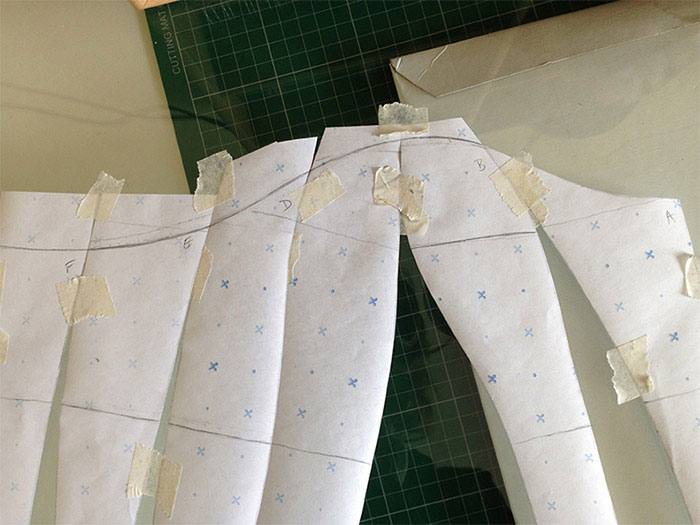
Now you simply cut the pieces down the middle and move them apart to make them bigger or together to make them smaller. The pictures below show how easy it is to alter this corset pattern.

Pattern piece we will be altering.


Cut down the middle, if your making the corset wider you will need a piece of scrap paper behind to stick the halves down on.

(Once you are competent with this method you can cut at the waist line too and angle the top or bottom in to make the bust or hips smaller, or angle out to make larger).


Use a ruler or tape measure to get the alteration the right size.


Stick the pieces back together and your done! You are ready to make a corset with your new pattern!

Remember the golden rule: Always make a mock up to check sizing, always always.


Technorati Tags: corset making, corset pattern, Corset Training, how to make a corset, make a corset

Corset Training Posse

Do you have a corset training posse yet? Yes I’m serious, no I’m not pulling your leg :p

With the advent of the internet and the onset of You Tube our whole world has gotten a lot smaller, which is a bad thing if your my mum and still can’t write a facebook post without it magically appearing under the wrong photo, but a great thing if your a tight-lacer. You can now watch several corset trainers on You Tube and track their progress inch by inch. You can also learn how to make a corset, put on a corset and check out before and after pictures online. Fantastic! But some are going that step further and getting a tight-lacing community together as well as pairing up with waist training buddies the other side of the globe! If you think you’d like to get involved with the corseted community you could do worse than join the facebook group we have at www.facebook.com/groups/corsettraining you’ll make friends and get advice.

Technorati Tags: Corset Training, how to make a corset

Comfort or glamour

Do you have to make a choice between comfort and glamour? I’ve found that with everything from shoes to underwear the world of fashion insists we make that choice, but does it have to be that way with the corset?

The obvious answer to the outsider would be yes, the corset is the epitome of vanity over comfort and only those with an extreme gratification for pain would disagree. Well I’m no seeker of discomfort and I definitely don’t enjoy the pain my 4 inch stilettos bring me, but I do enjoy a well made corset. It seems that (like with a custom made pair of shoes) the more expensive a corset the more comfortable. So yes you can have your cake and eat it but its going to cost you! The alternative is the home made route, obviously my favourite. The day I win the lottery I’ll pay Mr Pearl several thousand a pop to make my corsets, but until that day I’ll stay at my sewing machine thank you very much. Because a comfortable corset means a custom made one designed to fit your body specifically. So if you’ve not got the cash for a custom made every 6 months or so, but your adamant your going to take up corset training, take up corsetry too! Learn how to make a corset and you’ll save a packet as well as having the added satisfaction of being able to casually say – “What this? O I made this myself.”

Technorati Tags: Corset Training, corsetry, how to make a corset, make a corset

Corset Training – Related Articles Page

Check out the new Corset Related Articles page for full length articles on corset training and corset making. Its new up today and I’d love your feedback and more importantly your requests for future articles to add to this new page.

Future article topics will include bodice patterns and corset patterns as well as information on healthy diet and exercise while tight-lacing.

So check out the page and comment below with your suggestions.

Technorati Tags: corset making, Corset Training, how to make a corset

The bodice pattern takes shape

The bodice pattern is taking shape finally. We’re nearly there – yay – I’ve just got the edges to finish off. Like with all my new corset patterns, I couldn’t resist trying it on before it’s finished, just to check the sizing is right of course! :) So here are some photos so you can see how its looking, the fit is just right and I can’t wait to see how the tabs look once I’ve cut them (they’re all stuck together still to avoid premature fraying) I’ll be carefully cutting them appart and edging them in a few days time. First I need a rest and some retail therapy! I think the sewing machine will appreciate a bit of a rest and some quiet time too! I’ve been filming each stage as I go, this printable corset pattern will have its own video guide and work book as its a specialist bodice pattern. So the filming has been making the whole process take a lot longer. I hate being on film too so my nerves are shot! :) Click on the pics for bigger versions and a closer look. The red fabric is looking amazing, its my first use of heavy weight material as I always opt for the light cottons with the colourful designs. This bodice pattern may have converted me though! The feel is so much more luxurious and the sheen it has is fantastic.


Learning how to make a corset with fully boned panels has been time consuming but worth it, I love the bone channels and the effect they give.

Technorati Tags: Bodice pattern, corset pattern, how to make a bodice, how to make a corset

How to make a bodice pattern video

Today I started the filming for the exciting new Elizabethan bodice pattern! Yes filming! The next pattern in the printable patterns range will come with an optional workbook and video guide.

I’ve again been looking for a way to make my patterns easier to follow. The idea is that, like with the corset making DVD, nothing is more straightforward than seeing how its done. Having an instructional PDF workbook and MP4 video to download alongside the printable pattern is intended to make it possible for even the novice to complete this fully boned bodice pattern.

20120430-124605 PM.jpg

Technorati Tags: Bodice pattern, how to make a bodice, how to make a corset

Corset Training Corsets

Defining the Corset Training Corset:

The difference between a regular corset and a corset training corset or tightlacing corset is in the structure and strength. It is used for ‘body modification’ which means it has to have the strength to physically alter the shape of your body for extended periods of time until this becomes permanent to some degree (when taking off a corset you can’t expect your waist to not expand to some degree even after years of corset training).

To take this kind of long term strain a tightlacing corset has to be made of coutil ideally, I won’t go into the other materials that have been debated over the years, for me it has to be coutil. This is a strong stretchless cotton with a ‘herringbone weave’. Heres an example:-

The smaller the herringbone weave the less give the fabric should have and the better it is for corset making.

You can get satin coutils that aren’t herringbone weave, these materials aren’t as a rule as strong as the above type but make an excellent outer layer when coupled with a herringbone coutil lining. Which brings me onto my next point which is the layering. You can sometimes get by with a single layer of coutil, I’ve definitely seen a number of historic corsets made of a single layer. But remember the women that wore them had been corset training from a very young age and had tiny waists to support. If you are learning how to make a corset to reduce your waist substantially over time (or a customers waist), especially if it is a large or plus sized corset pattern – use two layers of coutil! You can often find three layer waist training corsets available commercially that have an outer layer of fashion fabric and two coutil layers for strength.

My last point to make on corset training corsets is the number of bones. Lets establish firstly tho that they should be made of steel not plastic. Often referred to as ‘steels’ corset bones can be made of two types of steel, sprung steel and spiraled steel wire, as below:-

Sprung steel boning comes with the ends rounded and tipped with a plastic. You can buy a continuous reel that can be cut with tin snips, rounded with a metal file and dipped in a liquid tipping fluid. Spiral steels need to be cut and capped with small metal U tips.

In a corset training corset you should expect to find the seams double boned, ie two bones at each seam with the seam running in-between. Some corsets will have more, the more bones the more strength and comfort the corset should provide. And that concludes the basics you should look for in a corset training corset.

Technorati Tags: Corset Training, how to make a corset, waist training

Free Corset Pattern – you can actually print off now!

↓CLICK ON FACEBOOK BUTTON TO GET THIS PATTERN FREE ↓


We have finally finished the launch for the new printable corset pattern range but fear not!  The free pattern page is still up! You can connect via facebook to get your very own copy of this beautiful and unique reversable corset belt pattern completely free! Then tell your friends about it to get hold of my pattern guide – which includes my secret list of the best places to buy corsetry supplies online! There are also several exciting new patterns available on the ‘Corset Patterns‘ page.


Get your pattern by clicking this facebook button ↓
I hope you all enjoy the corset belt, and as always good luck with all your corset making endeavors!


Technorati Tags: corset making, how to make a corset, make a corset

Elizabethan Corset Pattern Comes Together

The Elizabethan corset pattern comes together…slowly. The use of fully boned panels is new to me and I’m learning how, to make a corset with side by side boning throughout takes time! (And lots of spiral steel!) But I think you’ll agree it’s

looking like it’ll be worth it! My boyfriend seems to think I’ll be bullet proof in this bodice pattern but I won’t be testing the theory! It certainly has a completely different quality and feel to a corset pattern with boning at the seams only.

…and after all that practise, my sewing has never been straighter!


20120424-021855 PM.jpg

20120424-021954 PM.jpg

Technorati Tags: corset pattern, how to make a corset

Corset Training Belt – free corset pattern – sew along!

I’ll be sewing together a new reversible corset training belt in the coming weeks -and, wait for it, I’ll be doing it as a ‘Sew Along’ project! So you can learn how to make a corset belt with me by getting the free corset pattern here – Free-corset-pattern and literally sewing along day by day. So grab your corset pattern and print it off your home printer, then you can start looking at materials and collecting everything together.

I’ve bought some gorgeous shot silk dupioni fabric, not an ideal corsetry fabric but with such a small corset, wrinkling should be minimal and I plan to ruffle the front panel anyway. More on that when we get into the making. Heres the silk which I’ll be using for the outer fabric with the coutil lining.

Shot silk


So for now just raid your fabric cupboards!

Materials:

  • You’ll need a tiny bit of fabric for this corset pattern as its super small. A quarter meter will be enough.
  • A quarter meter of coutil for lining
  • 6 spiral bones for a single boned corset or 12 for double boned seams + 4 sprung steel bones for the lacing (or 2 lacing bones if you can get them). Sizes will be between 10 and 19cm, print the pattern in your size and measure the seams minus a half inch or 1.2cm.
  • 20 eyelets + setting tool
  • 2-3 meter laces


Technorati Tags: corset pattern, Corset Training, how to make a corset, sew along

More corsetry fabrics for the hoard

I have some more juicy fabrics for the historic corsets I’m making this month. These are especially nice for the Elizabethan ones I’m designing currently. And I’ve managed to get some nice ‘off white’ lacing cord to go with.
20120411-033117 PM.jpg

Technorati Tags: corsetry, how to make a corset, make a corset

© Copyright Corset Training - Designed by Pexeto