The Visual Effect of Sprung and Spiral Corset Bones
When making your corset training corset you should now know from my last post that steel bones are the way to go. You’ll also know that spiral steels are a lot more flexible and bend in many more directions than sprung steels. What you might not know is that when you make a corset, visually the effect of using the two different steels can give your corset different looks.
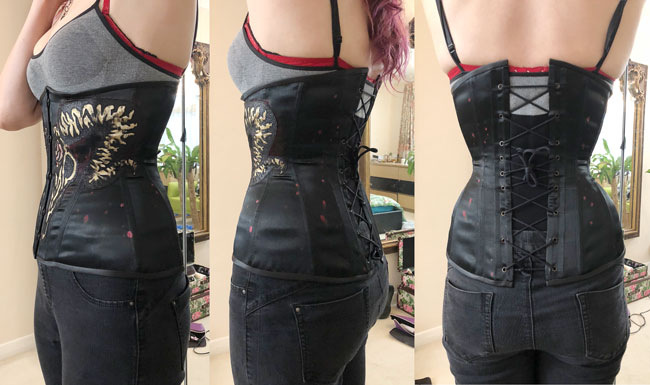
Again it’s to do with the bendable nature of the two steels. Sprung steel bends less so will actually give you a sleeker look, holding the original cut of the corset pattern. Where as spiral will conform to your body shape more closely. For example a round tummy will be held flatter by a corset training corset with sprung steels.
Corset Training Before And After
- At May 13, 2013
- By Kirsty
- In Corset Training, Historic Corsets
0
Your body will change shape instantly the moment you put on a proper corset training corset and tighten the laces. This is because the corset will displace the fat around your middle and hold your body in the shape of the constructed garment, so you can literally design your own body shape. However your body will return to its natural state once you take off the corset. Yes its a shame it can’t just stay put.
So what, if any are the permanent effects that can be achieved with a corset and how long do they take to make permanent?

Rib re-shaping
The only permanent change you can make to your body using corset training is to the lower ribs, which will compress over time to follow the shape of your corset. For this you’ll need a conical corset rather than one with an hour glass shape as these types leave room for the ribcage. Click here for more details on corset training shapes. The above and below pictures are a little extreme as they are copies from historic drawings, but it gives you an idea of the corset training before and after effects. The bottom floating ribs are easily reshaped as they’re not attached at the front. But it will still take a good 6 months to make a significant difference.

Internal Organs
If you plan on tight lacing to the extreme, your internal organs will be affected. The corset will restrict your waist, causing your organs to shift. This does place added pressure on your organs but this is similar to the pressure a woman’s body goes through during pregnancy. The female body is designed to take the added pressure and organ movement but if you plan on undertaking extreme tight lacing you should do so under your doctors supervision.
Body shape
The fact that the corset training before and after effects are not permanent and your body shape is merely held in position until the corset is removed, does not mean that corset training won’t have some effect on your body shape over time. We are talking years though, rather than months. The ribs are a solid bone structure so are unlikely to fully revert back to their original position, soft tissue however, will tend to expand back to its original shape. You would be best advised to corset train as a way of maintaining a slender figure rather than obtaining it, ie someone who starts to tight lace as a young woman will keep her figure thin even as an older woman. Thats why in Victorian times women where corseted as children. The body would form around the corset shape allowing them to maintain the waist size of a young teen. If you do waist train down to a tiny size and maintain it for several years before stopping, you’ll probably remain a great deal thinner than you would have been for several years. However there are reports of it taking under a year for the body to return to its previous size as, just like after pregnancy, the torso seems to remember its natural state. This really does vary from one person to the next though. Corset training really is more a way of life than an alternative to the surgeons knife or a healthy lifestyle. It’s no quick fix and should be undertaken for the joy of tight lacing and with a ‘long term’ mindset.
Corset Patterns for Corset Training (8)
…Measuring a plus sized figure for a corset training corset may mean the usual sizing method – taking the waist size minus 4inches and picking the corset pattern size that matches – results in a corset too big at the bust and hips. instead go by the bust/hips measurements instead.
Measure the bust at the fullest part with a well fitting non-padded bra on. This measurement should also have 4inches removed to get the ideal fit. The hip measurement can be taken at either (or both) the hip bone or the fullest part of the hips (normally level with the fullest part of the bum). This will depend on the corset pattern – whether it’s an on the hips or over the hips style. The hips measurement should have 2inches removed from it.
So why 4inches off the bust and waist but only 2inches off the hips? Well 2inches should be taken off everywhere to allow a 2inch gap at the laces but the waist is being compressed further for the corseted shape so we remove another 2inches. The bust is also traditionally pushed in and upward so we also take an extra 2inches off this measurement. Thus giving us the classic corset training shape.
TBC
Corset Patterns for Corset Training (1)
If your learning how to make a corset so you can make your own custom fit corsets for corset training then its important to know what to look for in a corset pattern.
You need to find a pattern that suits you in shape, some people prefer over the hips, some on the hips, the active person may want a waspie (shorter corset that allows more freedom but less stomach support).
The next thing to consider is the number of pattern pieces. A better more comfortable shape is always achieved with a larger number of pieces but this will also mean more work for the seamstress or corset maker.
Custom sizing is also important to consider. If your not confident enough to custom fit to the wearers measurement you need to try to get the hips and bust measurements as close to the wearers personal measurements as possible (remembering that a corset should be roughly 2 inches smaller than the wearers natural measurements at the hips/bust). You should also take care to make sure the waist is around 4 inches smaller than that of the wearer.
Construction is all important too but this is not a direct issue when finding a corset pattern to work from unless your relying on the instructions that come with it. (For a comprehensive corset making course check out my Express Corsetry Course for everything on how to make a corset for corset training purposes).
In the next few blog posts I’ll go into corset pattern shape/style, pattern piece numbers, sizing, and construction in more detail. In the meantime if you want to try a simple corset belt pattern try my free corset pattern at the bottom of the patterns page.
TBC
Designing the lace corset training corset2
Today I have been making a corset pattern for the lace covered corset training corset.
I’m patterning an overbust with the lines for the underbust top edge drawn on as I’m planning an overbust of a similar style as well as a bra potentially for the underbust, so it’ll be handy to have a pattern for the bust area. Hope that makes sense!
I’ve added a scalloped edge to the corset pattern, although I may drop it from the design. We’ll see.
Here’s a picture of the planned design, i’ll have images of the planned lace placement on the mock up tomorrow -
Making corset training corsets with lace
Corset training corsets can often be a little bland if you buy off the peg, but while making your own corsets it can be a little hard to find inspiration.
This week I’ve been looking at lace motifs, appliqués and lace overlays. Lace is a great way to spice up your corset making but a lot of people shy away from using it because they’re not sure how. It’s a very delicate fabric and one you don’t instantly associate with Corsetry but used as an outer decoration it can transform even the most dull corset into something quite stunning.
So next week I plan to start an underwear corset I’ve been designing for a while and add two layers of lace to the outside. I’ll be posting pictures and details on how I go about it so you can apply the same techniques to your own home made corset training corsets.
Here’s the basic design and the materials I’ve picked:
Corset Making Materials Question
- At January 5, 2013
- By Kirsty
- In make a corset
0
I was recently asked again about what materials should be used to make a corset from. So thought I’d go over it in length here.
A real corset training corset is made from at least two layers of material (Although I have seen some historical corsets with one) The inner or lining material should really always be coutil; which is a corsetry fabric made of cotton with a tight herringbone weave. I have known of several heavyweight materials with little stretch to them that have been used instead but in my opinion these aren’t as good. Never use denim, despite what you might think it’s very stretchy!
On the outside you can use more or less anything for your ‘fashion fabric’ layer or ‘decorative’ layer. Thicker materials that won’t wrinkle easily are by far the best for a professional look but I have often played with lightweight cottons although some starching or iron on backing fabric will add strength and help avoid wrinkling at the seams. The best materials by far are soft furnishing fabrics. The ones used for luxury cushions and curtains. These are a little more expensive but bare in mind you don’t need much.
How To Make A Bodice Article
We have a new article up on the articles page called How To Make A Bodice, Not A Corset. The point of which is to give you a bit more info on the difference between a bodice pattern and a corset pattern as well as the main differences between corset making and learning how to make a bodice.
All the skills needed are the same but there will still be some aspects of the bodice pattern not covered in basic corset design. Things like straps, tabs and the infamous fully boned panel.
Another thing to remember about the boned bodice or ‘stays’ is that the bodice pattern, by design, isn’t a good corset training choice due to its shape and lack of support below the waist line. That aside if you want a dramatic look for a period costume or fancy dress outfit and you don’t mind the odd gasp of admiration or jealous stare (who would) than an Elizabethan bodice pattern is the obvious choice for the corset maker.
Lacing cord
- At June 4, 2012
- By Kirsty
- In How To Make a Corset
0
If you make a corset you’ll have to find lacing cord for it. Also if you buy your corset and the laces wear out you’ll be wondering what you use as replacement lacing. I recommend not using shoe laces which are often the first port of call for corset making newbies. These stretch and are normally too short. I’ve also seen ribbon used which although it doesn’t stretch will wear out very quickly and start to fray.
It’s best to get lacing cord from a corsetry supplier so don’t forget to order it when you buy your busk and steel bones etc. you can get the flat shoe lace like laces but the tubular stuff is better, it’s a thin round cord and because it isn’t flat it can’t get twisted which looks unattractive.
When you buy get a 3 meter lace if your tightlacing as you’ll have enough slack to not have to re-lace every time you put it on. You can also get continuous lace, so you order say 10 meters and cut and tip it yourself. This is a lot cheaper and the colours available are more varied.
You can tip laces using 3 methods, plastic shrink tubing, metal lace ends and aglets.
For the plastic tubing you need to take needle and thread first and bind the ends of your laces by wrapping the end centimetre tightly. Then cut a centimetre of tube, place it over then lace end and use a lighter to heat it gently. The tube will shrink and grip the lace end.
Metal tips need pliers, you put the end in the tip and squeeze it shut.
Aglets are metal cones with prongs at the open end. You place the lace en in the cone and push the prongs in to hold it in place.
Altering Corset Patterns
I have been asked on numerous occasions to simply explain how to alter a corset pattern to fit someone bigger or smaller than the pattern is intended for. The easiest way to explain is with pictures. Click any of the photos below for bigger images.
So you have your corset pattern like this -
This is a pattern for half a corset so measure the waist line of each piece and add them together to get half the waist. Double this and you have the total waist size for this corset pattern.

Measure your waist size (or the person who will wear it) if the corset is to be smaller than their waist take off 2 – 4 inches to get the size you need the pattern to be.
You may need to add a few inches to the waistline to make it fit, or take off a few.
Say the pattern above will make a corset with a 24inch waist but I need it to have a 27inch waist – so 3 inches bigger. The pieces above are for half the corset so I need to add 1.5 inches to them. I decide where to add them by looking at the pieces; I decide to add 0.25 inches to each piece with the exception of the thinnest one which I’ll add 0.5 to. If I were taking away 1.5 I might decide to take more away from the fatest piece. The added width does not have to be perfectly distributed, don’t over think this!
Now you simply cut the pieces down the middle and move them apart to make them bigger or together to make them smaller. The pictures below show how easy it is to alter this corset pattern.
Pattern piece we will be altering.
Cut down the middle, if your making the corset wider you will need a piece of scrap paper behind to stick the halves down on.
(Once you are competent with this method you can cut at the waist line too and angle the top or bottom in to make the bust or hips smaller, or angle out to make larger).
Use a ruler or tape measure to get the alteration the right size.
Stick the pieces back together and your done! You are ready to make a corset with your new pattern!
Remember the golden rule: Always make a mock up to check sizing, always always.
Corset Training – Related Articles Page
- At May 20, 2012
- By Kirsty
- In Uncategorized
0
Check out the new Corset Related Articles page for full length articles on corset training and corset making. Its new up today and I’d love your feedback and more importantly your requests for future articles to add to this new page.
Future article topics will include bodice patterns and corset patterns as well as information on healthy diet and exercise while tight-lacing.
So check out the page and comment below with your suggestions.
Free Corset Pattern – you can actually print off now!
↓CLICK ON FACEBOOK BUTTON TO GET THIS PATTERN FREE ↓
We have finally finished the launch for the new printable corset pattern range but fear not! The free pattern page is still up! You can connect via facebook to get your very own copy of this beautiful and unique reversable corset belt pattern completely free! Then tell your friends about it to get hold of my pattern guide – which includes my secret list of the best places to buy corsetry supplies online! There are also several exciting new patterns available on the ‘Corset Patterns‘ page.
Get your pattern by clicking this facebook button ↓
I hope you all enjoy the corset belt, and as always good luck with all your corset making endeavors!
To Bodice Or To Corset: that is the question!
Are you making a bodice or a corset I ask?
Whats the difference?
I here you retort, well that’s the topic of this blog post, and the answer is actually quite a lot.
I used to think it was all in the layers, a corset had two or more while a bodice had just the one. But I have since seen bodices of more and corsets (my own vintage historical ones) with less. So I looked into it.
It turns out that (and this is still not definitive so if you have other evidence to offer up please do) a bodice is made to the exact measurments of the wearer while a corset is made smaller than the wearer! Yes if you want a corset to look right it should be at least two inches smaller at the waist (plus at least an extra inch smaller to allow for the gap at the laces if you want it).
There are lots of theories on the differences between the two so there is no way to say this is it definitively, but as the modern day ‘bodice block’ is made to the wearers exact measurements then ‘ease’ is added when the garment is made (more ease for a shirt and less for a fitted top) this does seem to fit as an explanation. Bodices were of course around first dating back to the 1600s, there are shape and style differences, cloth qualities and bodices are normally much more heavily boned than corsets, but this is the major factor that I’ve found makes the most sense.
Corsets and Haute Couture
A book of high fashion by Dior this is hot off the press and a must have if your fashion obsessed like me. There are some nice corseted pieces as u can see here in this magazine article I came across. But the whole book is in French so if your not multilingual your buying it for the pictures only, which to be honest is enough in this case!
Corsetry and pin ups
- At March 17, 2012
- By Kirsty
- In How To Make a Corset
0
For those of you learning how to make a corset this might amuse! I had to share this image of one of my fave pin up artists paintings from the 50s. Gil Evgren painted hundreds of tiny waisted 50s bombshells. This ones of a girl making a corset!
How To Make A Corset Some Matching Bias Binding
- At March 11, 2012
- By Kirsty
- In How To Make a Corset
0
Want a really professional finish to your corset making? Then make your own bias binding.
Don’t get me wrong I use the pre-made bias binding a fair bit, but for when the shop bought plain colors just don’t sit right with your beautiful corset fabrics, go one better and make your own. It also means you can customize the width of the binding, so if you have tighter corners you can make it thinner to cope better with the harder turns. Thinner binding is also easier to handle when your learning how to make a corset.
Different widths of binding
Sounds great you say? Well lets get going!
You’ll need to have bought (or go back out and buy) a bit extra fabric in your chosen corset material. A half meter, or even a quarter meter will just about do but bare in mind the narrower it is the more joins you’ll have.
You need to grab a set square with a 45degree angle or take a piece of paper and fold the top edge down so it meets the left edge and flatten (45degrees is just half a 90degree angle like the one at the corner of a piece of paper). Now place the 45degree triangle against the edge of your material at the top and draw along the diagonal. Use a ruler to continue the line across the material to the other side. Use the angle and ruler to draw more lines all the way down your fabric which you will cut along to make your bias strips. You need to make sure your strips are four times the width you want your binding to be as you will be folding the strips in half twice to make the binding. So a half inch binding will require 2inch strips. Join your strips together by lining the edges up right-sides together and sewing them together with a small seam allowance of about 5mm. Then open out and press open the seam allowance before trimming it so no seam allowance sticks out beyond the edge on the right side.
Now for the folding! You can get a little folding tool that you push the binding through and pull out the other side folded. You just pull the binding through and iron as it comes out. But if you don’t have time to go out and get one you can fold the binding in half and iron it, then open it again and fold each raw edge into this center crease and iron again. Once both edges are folded into the center and ironed flat your done!
The Importance Of Using Bias Binding In Corset Making
First let me explain to those new to corset making who don’t know; what bias binding is and where it goes. If your just learning how to make a corset you may not have come across it yet but bias binding is the stuff that goes along the top and bottom edge of your corset. It incloses the raw edge and finishes the corset – in short it makes the corset look professional.
Now, again, if your new to corsetry you may be forgiven for thinking that all binding is created equal, but any seasoned seamstress will set you straight on that. O no no, if you’ve ever seen a cheap website with those £20 – £50 corsets and wondered why the edging is rucked up and creases round the curves of the bust and under arm area, I can tell you now its because bias binding wasn’t used.
As the name suggests its strips of material cut on the bias. The edges are then folded in to the middle and the whole thing is folded in half again to inclose the raw edges. The important thing about cutting on the bias is the way the binding can stretch on the diagonal. This allows it to stretch round curved edges leaving a smooth wrinkle-less finish. So when you make a corset don’t finish off your edges without it – make sure you use bias binding.
Some of My Bias Binding in Satins and Cottons
How To Tell Its Bias Binding
- At March 10, 2012
- By Kirsty
- In How To Make a Corset
0
Its important when sewing corsets to use bias binding on your corset edges both top and bottom because, as we discussed in the last post, the stretch properties of fabric cut on the bias allows it to go round the undulating curved edges of your corset without puckering up or leaving unsightly wrinkles.
When your learning how to make a corset its a good idea to learn how to check the binding you have is cut on the bias. You can do this by having a close look at the fabric its made of to see which way the grain runs. If its clear the grain is running diagonally across the length of the binding you know you have the right stuff. Also look for the joins in the binding, these will normally also be diagonal. If still in doubt lay it on a flat surface and bend the binding into a gentle curve, how does it react? If you can smooth it down with your finger and it doesn’t wrinkle at the inner edge of the curve then its bias binding.
Stay tuned as tomorrow I’ll be telling you how to make a corset its very own bias binding in matching fabric!
New Angel Corset Pattern
- At March 1, 2012
- By Kirsty
- In Corset Patterns, How To Make a Corset
0
I have another new downloadable and printable corset pattern for sale! The Angel Underbust which is made with a larger number of panels to make it super curvey and allow for more seamed boning – this means you can use it to make corset training strength corsets. It also has a few special features to make it extra versatile!
It’s low cut at the front which allows for a lot more movement than you would normally get in a corset thus making it my most comfortable corset yet.
It also has two separate bottom edges on the pattern marked in black and red giving you a chose of styles.
Lastly it comes with two front panels so you can chose to have a busk hiding front flap like in the picture below which creates the look of a front closed corset while allowing you the convenience of a front closure, brilliant! (If I do say so myself)
So if your learning how to make a corset you might want to try this corset pattern on for size
The Angel Underbust Corset Pattern (click pic for a bigger version)
Corset Training Affiliate Program!
- At February 29, 2012
- By Kirsty
- In How To Make a Corset
0
I have finally got round to creating an affiliate program! What’s an affiliate program? You say.
Well if you have a sewing blog or a corsetry/craft newsletter you send out, you can now sign up on this affiliate page and advertise my DVD for a commission of 50%. Its like being a book seller or a ‘re-seller’. You recommend a product for a percentage of the sale price. This is a great opportunity if you run a website and want to do it for a living or earn some cash recommending a product you like. (If you like it, it would be silly to recommend it if you don’t). Its also great for me because I get my work seen by more people.
If you want more info click the link above but basically you get a link to promote which you can add to emails of websites and sales made through your unique link are recorded and you get paid your 50% at the beginning of each month. Here are some adverts I’ve made especially for my affiliates to make it even easier!